
Reduced Support contacts for repeat deliveries from 10% to 2%.

UX Strategy, Research, and Design
2024
B2C E-Commerce
Pet Circle has established itself as Australia's largest online pet retailer, heavily relying on repeat deliveries to drive sustainable business growth. The Auto Delivery program allows pet owners to set up recurring orders for essential items like food, treats, and medication. This automated replenishment model is critical to the company's bottom line, with repeat customers making up over 100,000 monthly buyers and contributing close to 40% of the total annual revenue.
However, beneath this massive scale, the user experience of managing these subscriptions was causing significant friction.

Challenge
The core premise of an automated delivery service is that customers can set their preferences once and rarely think about them again until their needs change. Unfortunately, the existing platform architecture forced users into a rigid, fragmented system that made routine adjustments incredibly difficult.
Customers were experiencing high cognitive load when trying to decipher their upcoming shipments, leading to a stark drop in retention. In fact, data showed that the business struggled to retain repeat delivery customers for more than two consecutive deliveries.
Results
Prior to the launch, over 10% of repeat customers were forced to contact customer support every month just to make routine changes to their deliveries. Following the rollout of the new self-service portal and the PDP optimizations, that metric plummeted. We successfully reduced support contacts for repeat deliveries down to 2%.
8%
Reduction in Support contacts
100k+
Customers impacted
40%
Revenue share optimised
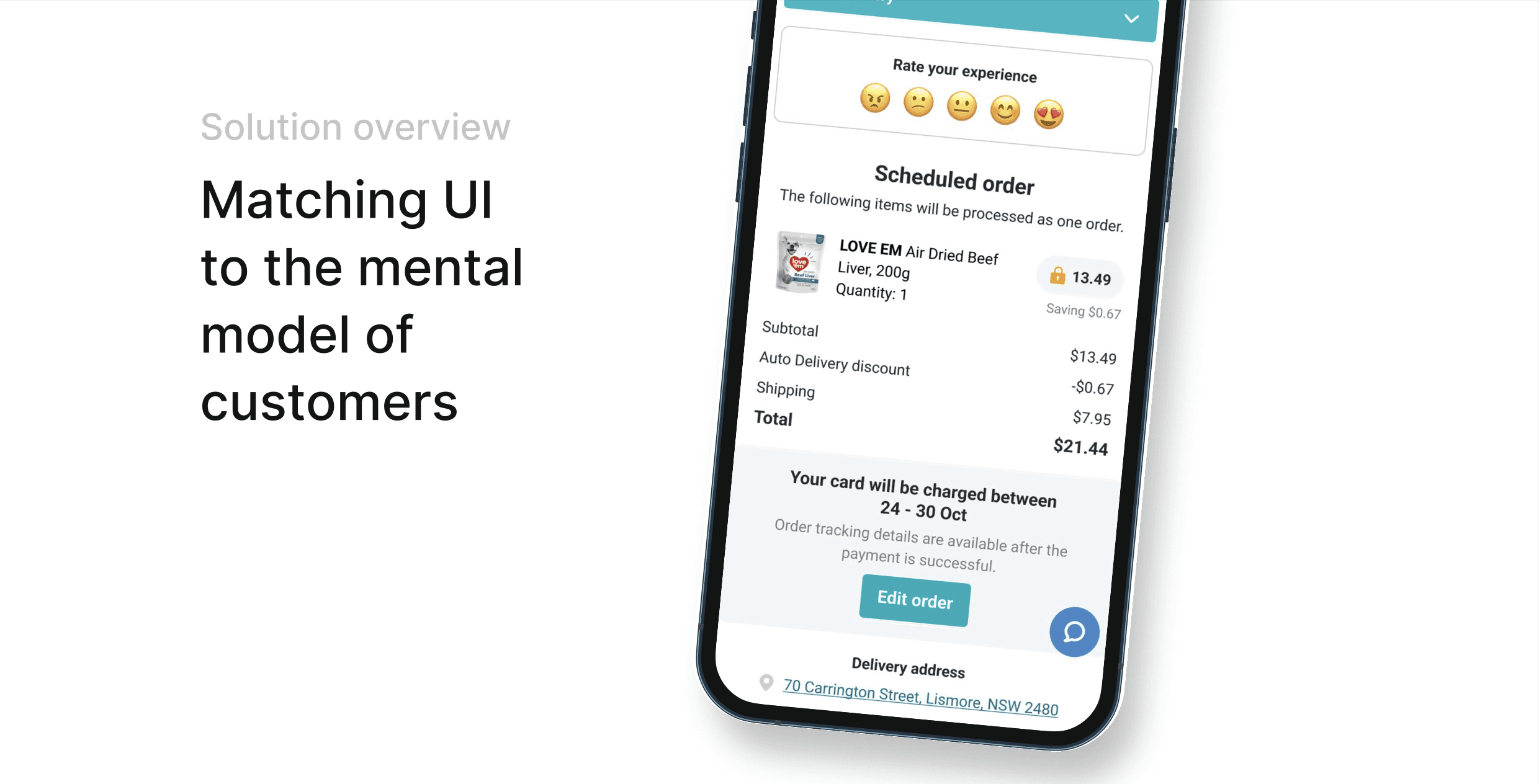
Matching Information Architecture to Customer's Mental Model
Process Details
UX Research
As the Senior Product Designer on this initiative, I led the end-to-end overhaul of the Auto Delivery management UX. Working alongside cross-functional Product and Technology teams, my goal was to diagnose the root causes of customer churn and design a scalable, intuitive interface.
We needed to transform a convoluted system into a seamless self-service portal, ultimately reducing support dependency and increasing long-term customer lifetime value.
"Impossible to add to existing auto delivery ! I shall now make another separate order. This happens every time ! No time to contact customer service agent yet again!"
Frustrated Pet Circle Customer

The baseline experience illustrating fragmented Delivery Groups
A deep dive into the baseline desktop experience revealed a severe mismatch between the back-end system architecture and the customer's mental model. Items scheduled to arrive on the exact same date were arbitrarily split into separate, fragmented 'Delivery Groups' (e.g., Delivery Group 16, Delivery Group 18).
This led users to believe they were receiving multiple separate shipments and potentially paying multiple shipping fees. Furthermore, the interface lacked basic billing transparency, leaving users entirely in the dark about when their credit cards would actually be charged.
10%
Customers rely on customer support to manage their repeat deliveries
23%
Customers who reschedule deliveries immediately after being reminded via Email or SMS
“I used the $15 Black Friday coupon even though I have Auto Delivery for a 12kg bag of kibble. Two orders went through by mistake and I reversed the Auto Delivery one because it was more expensive without the Black Friday coupon.”
Customer Interview Participant
UX Research: Understanding Repeat Customer Behaviours
Auditing customer feedback highlighted three recurring themes: confusion over delivery dates, anxiety regarding billing schedules, and an inability to adjust item frequencies.
We found that approximately 23% of customers only attempted to reschedule their repeat deliveries after receiving an automated reminder, at which point they frequently encountered these UI roadblocks. The friction was so severe that many users resorted to manually purchasing items outside of their subscription, actively bypassing the very system designed to save them time.
Customer interviews, feedback audits, and heuristic evaluation
We analyzed direct and indirect competitors—including Amazon, Woolworths, Coles, and Budget Pet Products—to establish baseline patterns for recurring delivery management. A key learning from this competitive analysis was that customers already possess a firmly set pattern and mental model for how to manage repeat deliveries, heavily influenced by major grocery and retail platforms.
Amazon: Unified 'Subscribe & Save' management hub with clear skip/cancel actions.
Woolworths: Strong alignment of delivery windows with recurring billing expectations.
Budget Pet Products: Basic subscription management, but lacks granular inline item editing.

Routine Builder: desires predictability, valuing the ability to automate feeding schedules without worrying about manual reordering
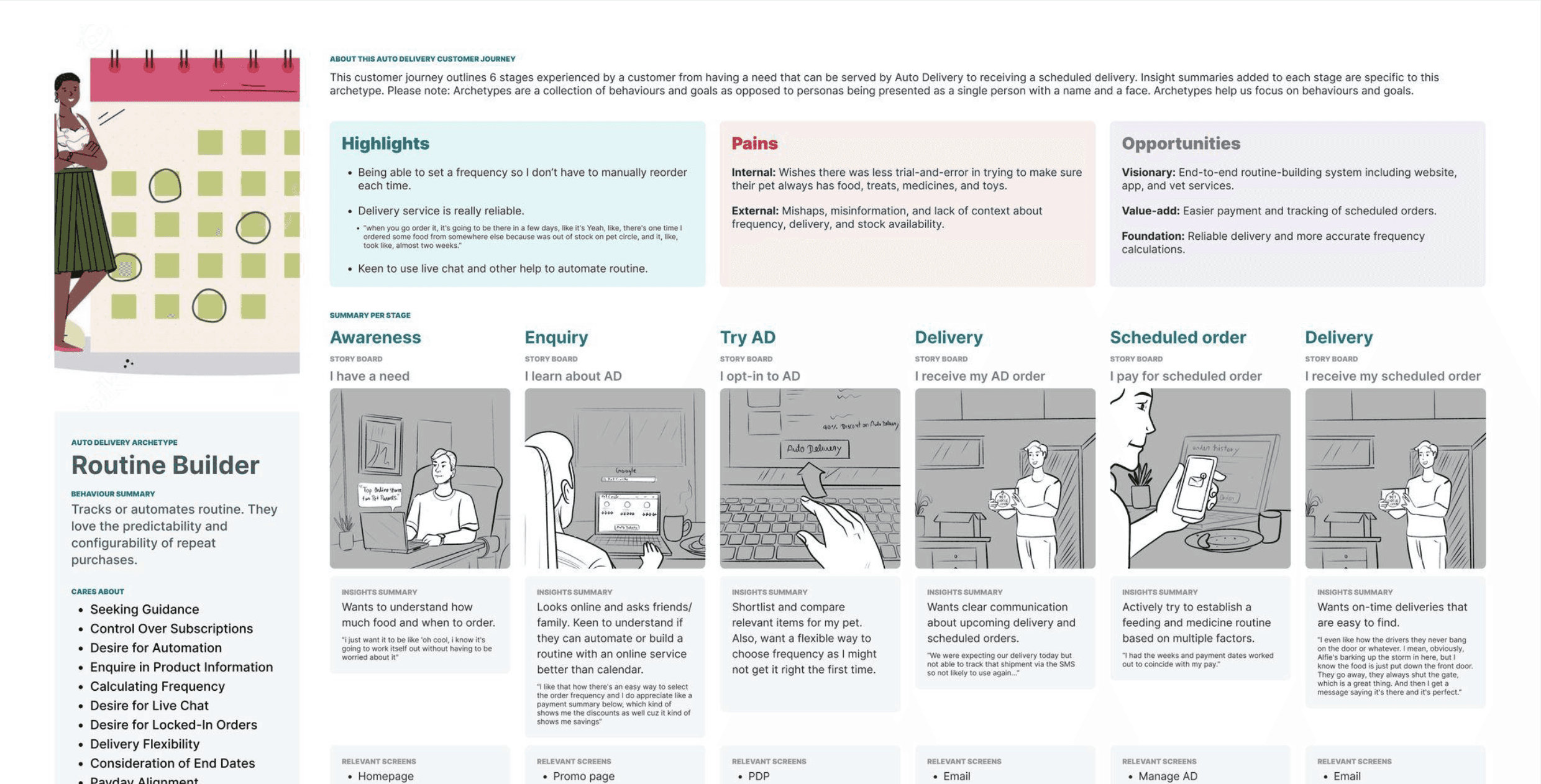
Savvy Saver: highly discount-oriented, subscribing primarily to secure stock reservations and loyalty benefits

The 2 archetypes we discovered had distinct behavioural differences. However, they shared a reliance on proactive communication, specifically utilising the 7-day reminder email as their primary trigger to check pantry stock and adjust their upcoming orders.
Discovery: Critical gap between service design and customer communication
We discovered a critical gap: while the warehouse processed orders every Sunday (T-7 days), the front-end communication lacked clarity regarding exact processing dates. Aligning these front-end touchpoints directly with back-end fulfillment milestones became a mandatory requirement for the new experience.

UX Strategy: Framing the challenge
During these discussions, we identified a significant constraint: engineering availability was limited, preventing us from overhauling the entire shopping and checkout infrastructure at once.
To mitigate this blocker, we formulated a staggered, two-stage release strategy. The primary objective for Stage 1 was to fix the core interface by matching the mental model of the customers, deferring the deeper integration of repeat deliveries into the broader shopping experience to Stage 2.
We crystallized our strategy into three guiding pillars that would serve as our North Star for the redesign:
First, we had to 'Match the mental model' by consolidating fragmented orders.
Second, we needed to 'Improve visibility of repeat orders' by providing explicit billing and processing dates.
Finally, we aimed to 'Increase ways of creating repeat orders' by optimizing touchpoints like the Product Detail Page (PDP) to prevent accidental duplicate subscriptions.
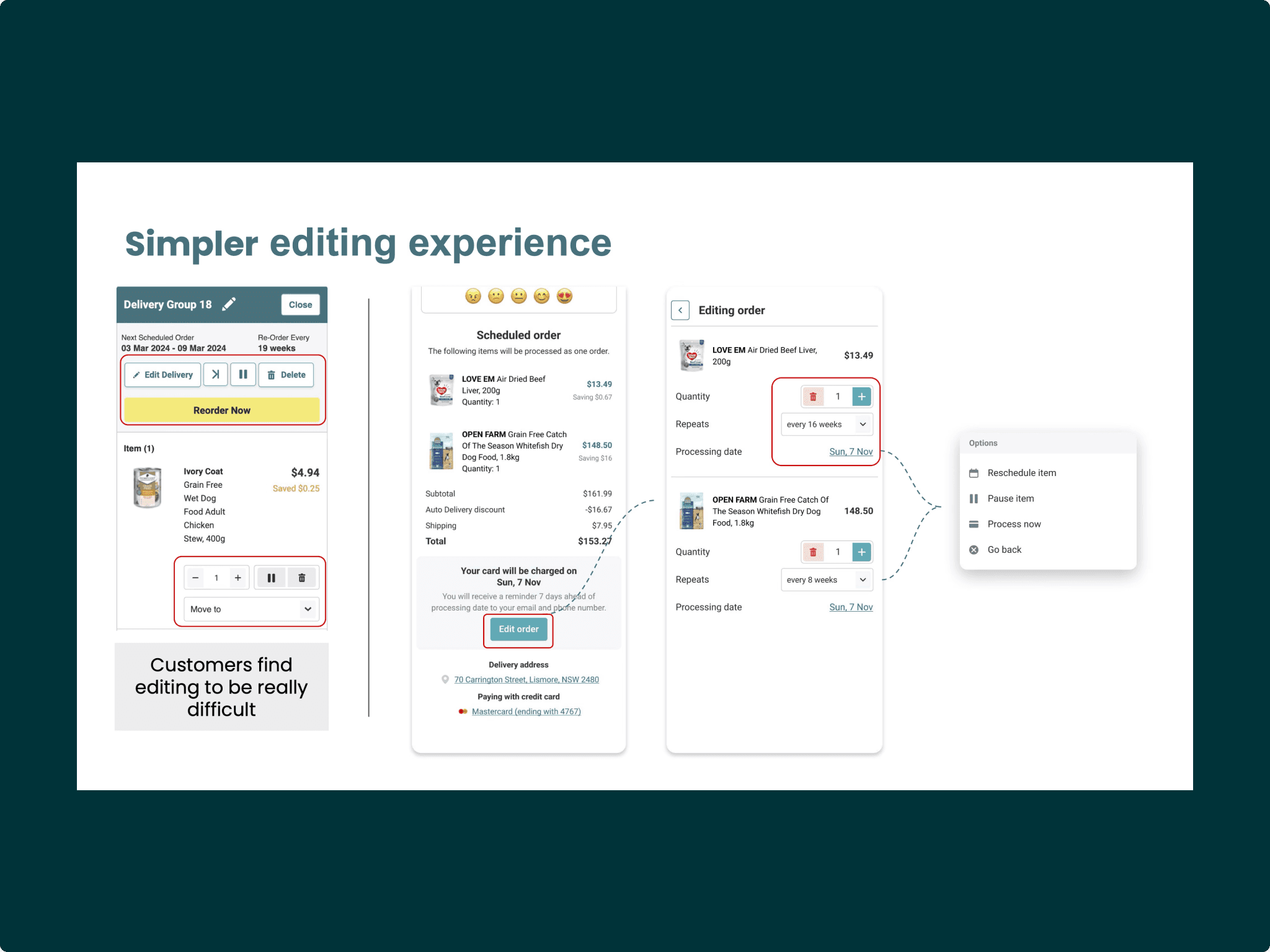
Before: edit buttons duplicated and confusing. After: contextual editing based on heuristic evaluation and usability testing on Maze
The Solution: Matching the Mental Model
The cornerstone of the final solution was the complete consolidation of the order management interface. We successfully eliminated the confusing 'Delivery Group' nomenclature. In the new UI, any items scheduled to be delivered together on the same date are automatically grouped into a single, unified 'Scheduled order' card. This direct alignment with the customer's mental model immediately alleviated fears of being double-charged for shipping and clarified exactly what was arriving in the next box.
To address customer anxiety regarding billing, we introduced explicit financial transparency directly into the order summary card. The redesigned interface now prominently displays a clear date range indicating exactly when the user's credit card will be charged (e.g., 'Your card will be charged between 24 - 30 Oct' or 'Your card will be charged on Sun, 7 Nov'). We paired this visual update with the proactive 7-day reminder alert, ensuring users had ample time to make adjustments before any financial transaction occurred.
We also completely overhauled the item editing experience. I introduced an inline 'Editing order' interface that replaces the old, fragmented flow. Users can now tap directly into an item to reveal contextual controls for adjusting quantity, modifying the repeat frequency, and selecting a new processing date. By keeping the user within the context of their overall order, we drastically reduced the cognitive load required to manage complex, multi-item subscriptions.

The Solution: Optimizing the Product Detail Page
Beyond the core management portal, we needed to address a critical behavioral pattern occurring on the shopping side of the platform. Research indicated that when customers ran low on stock at home, they tended to repeat their behavior of manually navigating to the Product Detail Page (PDP) to buy the item again. In the baseline experience, this action would inadvertently create a brand new, duplicate Auto Delivery subscription, compounding their management woes.
To solve this, we introduced an intelligent intervention on the PDP. The system now checks if the customer already has the viewed item on an active Auto Delivery schedule. If a match is found, the standard subscription opt-in is replaced with an explicit status banner stating, for example, 'You have scheduled this item to be processed in 10 days on Thu, 24 Nov.'
Alongside this contextual banner, we replaced the primary 'Add to my Auto Delivery' call-to-action with a direct 'Manage order' shortcut. This seamless redirection encourages users to modify their existing subscription—perhaps by utilizing the new 'Process now' feature—rather than accidentally creating a duplicate. This proactive UI adjustment was vital in preventing future support tickets at the source of the user journey.
Conclusion
The Stage 1 release of the redesigned Auto Delivery experience launched to our customer base in early 2024. By aligning the interface directly with the users' mental models and introducing granular, inline editing capabilities, we empowered customers to confidently manage their own recurring orders. The addition of explicit billing dates and unified order cards immediately reduced the confusion that had previously driven users to seek external help.
Prior to the launch, over 10% of repeat customers were forced to contact customer support every month just to make routine changes to their deliveries. Following the rollout of the new self-service portal and the PDP optimizations, that metric plummeted. We successfully reduced support contacts for repeat deliveries down to 2%.
8%
Reduction in Support contacts
100k+
Customers impacted
40%
Revenue share optimised